

Flat Site Visit and Possession Checklist for Nagpur Buyers
Run three visits — weekday morning for utilities at peak load, weekday evening for security and lighting, weekend morning for parking and common areas — and inspect your actual unit for room dimensions, ventilation, plumbing fixtures, electrical points, door and window alignment, finishing quality and a snag list of defects.
flat site visit checklist Nagpur needs a clear goal, written evidence and an independent check before payment. This guide turns those steps into a practical buyer workflow.
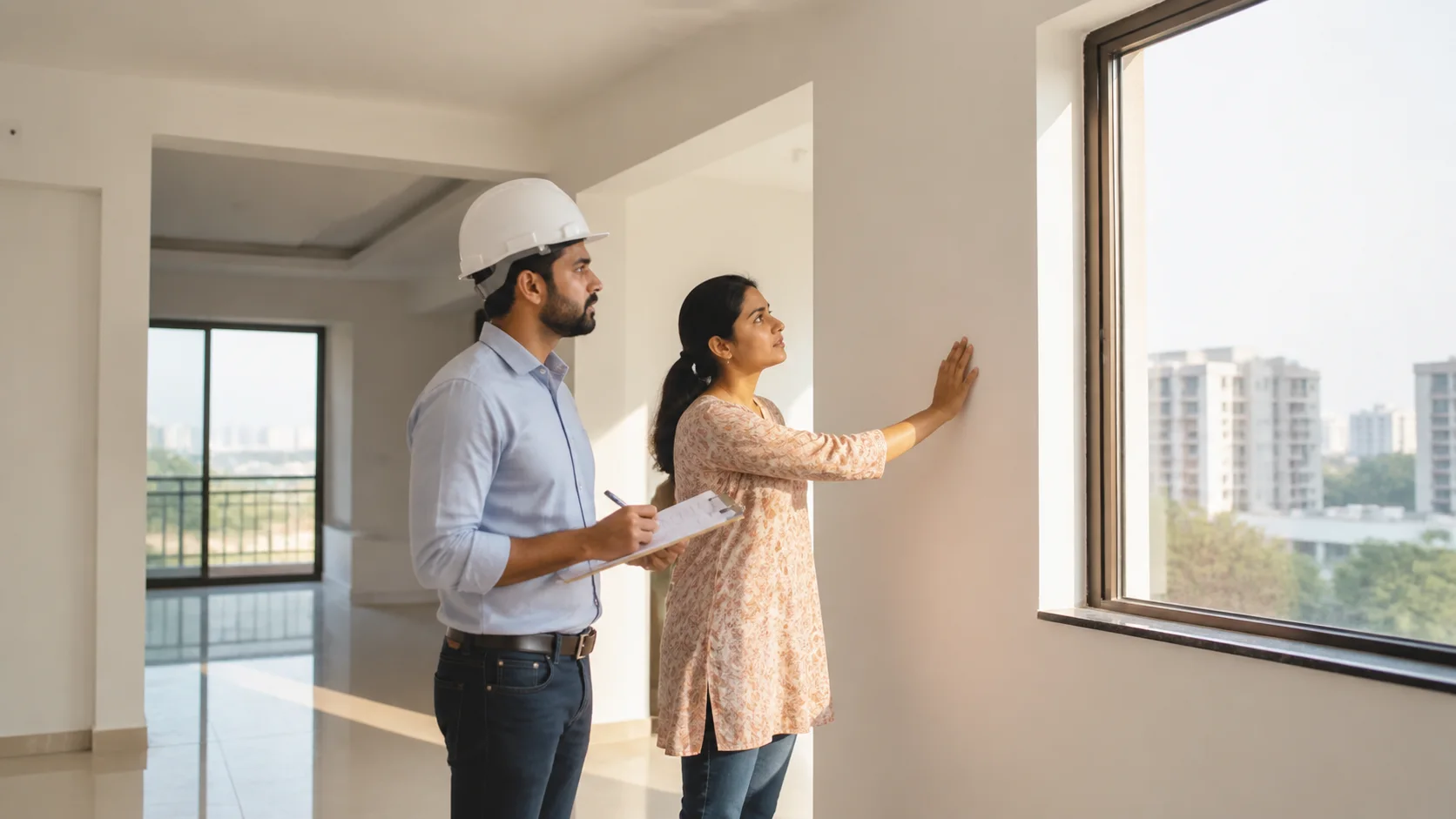
flat site visit checklist Nagpur: quick buyer summary
Related questions covered: flat possession checklist Nagpur, home inspection checklist Nagpur, and new flat buying checklist Nagpur. First, shortlist with evidence. Next, compare like with like. Finally, record every promise in writing.
What a good site visit actually checks
Direct answer: A disciplined Nagpur flat site visit checks six categories — neighbourhood, sample flat, actual unit, common areas, utilities, and documents — across three visits at three different times of day. The brochure sells the marketing; the site visit captures the reality. Skipping any one of the six categories leaves a real gap in your decision.
Carry this checklist printed. The most expensive defects — water pressure at peak hours, parking overflow at night, ventilation in the actual unit, snags in the finishing — are only visible in person, at the right time.
Visit 1: weekday morning — neighbourhood and utilities at peak load
Direct answer: A weekday morning visit shows you the commute you'll actually do, the school traffic at drop-off, and the water and electricity supply when 60–80% of residents are using them simultaneously. It is the single most revealing time to inspect a Nagpur project.
- Commute test. Drive from the project to your office at the time you would actually commute. Time it. Note congestion points.
- Water pressure. Visit a friend's flat in the project if possible, or ask the sales team to run multiple taps in the sample flat. Low pressure on a quiet site visit becomes unusable showers in peak summer.
- Electricity load. Check whether the lift, common-area lighting, and your flat's appliances can run simultaneously without tripping. In summer, this is the test that catches undersized transformers.
- School and hospital access. Drive past the closest school and hospital during drop-off hours. A 10-minute drive in Google Maps becomes a 25-minute reality at 8:15 am.
- Construction noise. If the project is under construction, the noise is intense during the day. Ask the builder about working hours and noise mitigation.
Visit 2: weekday evening — security, lighting, and noise
Direct answer: A weekday evening visit shows you what your daily life will look like after work — street lighting, security presence, lift crowding at peak, and how the building looks at night. It also surfaces the noise reality from traffic, neighbours, and commercial activity nearby.
- Street and internal lighting. Walk from the gate to your block after dark. Note every dim patch.
- Security posture. Watch the security desk for one shift. Are visitors logged? Are delivery agents checked? Is CCTV coverage visible?
- Lift waiting time. Time the lift during peak return hours (typically 7–9 pm). Anything above 5 minutes is a flow problem.
- Ambient noise. Stand on your future balcony for 10 minutes. A site visit during quiet hours often misses the reality of late-night traffic or commercial activity.
- Neighbouring land use. Is there an empty plot that could host a future commercial development? A hospital, school, or industrial site next door is a different reality than today.
Visit 3: weekend morning — parking, common areas, and family reality
Direct answer: A weekend morning visit shows you how the building behaves when everyone is home — parking filled, common areas crowded, clubhouse booked out, and kids playing. It also reveals how the management committee (if any) handles day-to-day operations.
- Parking reality. Walk the basement and stilt parking. Are spots marked by flat number or first-come-first-served? Visitor parking — is there any?
- Common-area cleanliness. Stairs, lifts, lobby, and waste management. A clean common area is a strong signal of an active management committee.
- Clubhouse and amenities. Are they usable? Or are they in name only? Ask whether they are operational, chargeable, or under construction.
- Children's play areas. Are they safe? Is the equipment age-appropriate? Is there shade?
- Water storage and STP. Ask about underground water storage capacity, STP (sewage treatment plant) uptime, and rainwater harvesting.
The actual flat checklist (your specific unit)
Direct answer: Inspect your actual unit — not just the sample flat — for room dimensions, ventilation, plumbing fixtures, electrical points, door and window alignment, finishing quality, and snag-list items. Sample flats are designed to look their best; your unit may have different sun orientation and different neighbour adjacency.
- Measure room dimensions. Carry a tape and verify the carpet area matches the agreement. Discrepancies of even 5% can mean a different apartment in practical terms.
- Check ventilation. Open every window. Is cross-ventilation possible? Are any rooms dark or stuffy?
- Inspect plumbing fixtures. Run every tap for 60 seconds. Check for leaks below sinks and around toilet bases.
- Test electrical points. Carry a phone charger. Test every socket. Confirm the distribution board has separate MCBs for lights and power.
- Inspect doors and windows. Open and close every door and window. Check alignment, rubber seals, and locking mechanism.
- Look for finishing defects. Tiles, paint, plaster, joints, and corners. Photograph anything you are not satisfied with.
- Sunlight at different times. If possible, visit the unit at morning, noon, and late afternoon to capture the sunlight pattern.
The snag list — what to record before possession
Direct answer: A snag list is a written, dated record of every defect — tile crack, paint drip, door misalignment, plumbing leak, electrical issue — that you record before taking possession. The builder is contractually obligated to fix these within a defined window after you flag them. Without a snag list, you lose the strongest protection you have against poor finishing.
Carry the list below to your possession visit and tick each item. Photograph everything.
| Area | Item to check | Status |
|---|---|---|
| Doors | Alignment, locks, paint finish, weather-stripping | |
| Windows | Glass, frame, sliding, grills, mesh | |
| Flooring | Tile cracks, hollow sounds, grout, skirting | |
| Walls | Paint, plaster, damp patches, putty finish | |
| Ceiling | Cracks, seepage marks, height consistency | |
| Plumbing | Taps, drains, flush, water pressure, hot water provision | |
| Electrical | Sockets, switches, MCB labelling, AC points, earthing | |
| Kitchen | Counter, sink, exhaust provision, gas pipeline, drainage | |
| Bathrooms | Tile joints, slope toward drain, anti-skid, exhaust fan | |
| Balcony | Slope, railing height, drainage, waterproofing |
The documents to bring to the site visit
Direct answer: Carry the MahaRERA project page (saved as PDF), the agreement draft, your ID, a measuring tape, a phone with camera and a portable charger, and a notebook. These five items let you capture evidence on the spot and reconcile what you see with what the builder has committed to in writing.
The full list of documents to verify before the visit is in the documents checklist guide.
How the site visit connects to possession
Direct answer: The site visit you do before booking is for decision-making. The site visit you do at possession is for snag-list capture and OC verification. Both matter, and they are different events. Schedule the possession visit during daylight hours and budget 2–3 hours to inspect the unit and common areas thoroughly.
What to do if you find serious defects
Direct answer: Document the defect with date-stamped photographs, write to the builder's customer desk with the same defect list, and ask for a written timeline for rectification. If the defects affect structural integrity, water-tightness, or electrical safety, escalate to the architect or structural engineer of record. MahaRERA also accepts complaints online for builder non-compliance with possession commitments.
Quick printable site visit checklist
- [ ] Commute time recorded for office and school
- [ ] Water pressure tested at peak hour
- [ ] Electricity load tested with multiple appliances
- [ ] Lift waiting time recorded at peak hour
- [ ] Parking spot verified and marked
- [ ] Common-area lighting and security reviewed
- [ ] All rooms measured against agreement carpet area
- [ ] Cross-ventilation checked in every room
- [ ] Sunlight pattern observed at multiple times
- [ ] MahaRERA project page matched with site board
- [ ] Snag list completed and date-stamped
Editorial standards and sources
Reviewed September 2026. Regulatory references accurate at the time of writing.
Primary sources cited in this article:
Projects referenced:
- Hilltop Heights-11 — premium 3 BHK in Ram Nagar.
- Hilltop Heights-14 — 2 BHK with Vastu-compliant layouts.
- Hilltop Heights-16 — family-focused mid-segment project.